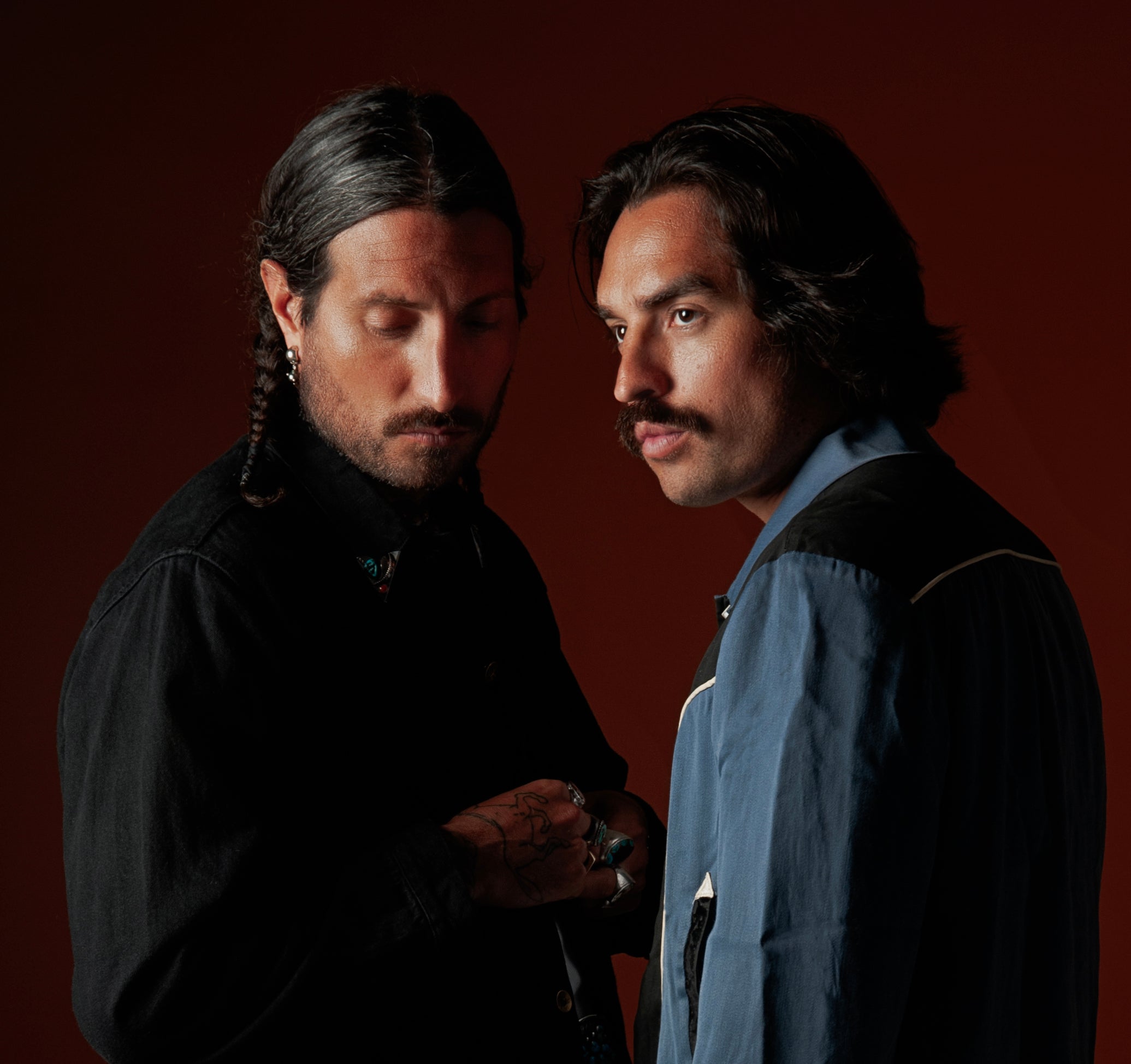
“This is a love letter to South America,” says Alejandro Gutiérrez. “What we want to do with this record is to invite people to come on another journey with us, this time through the Andes and to create a curiosity for this culture and for this part of the world.”
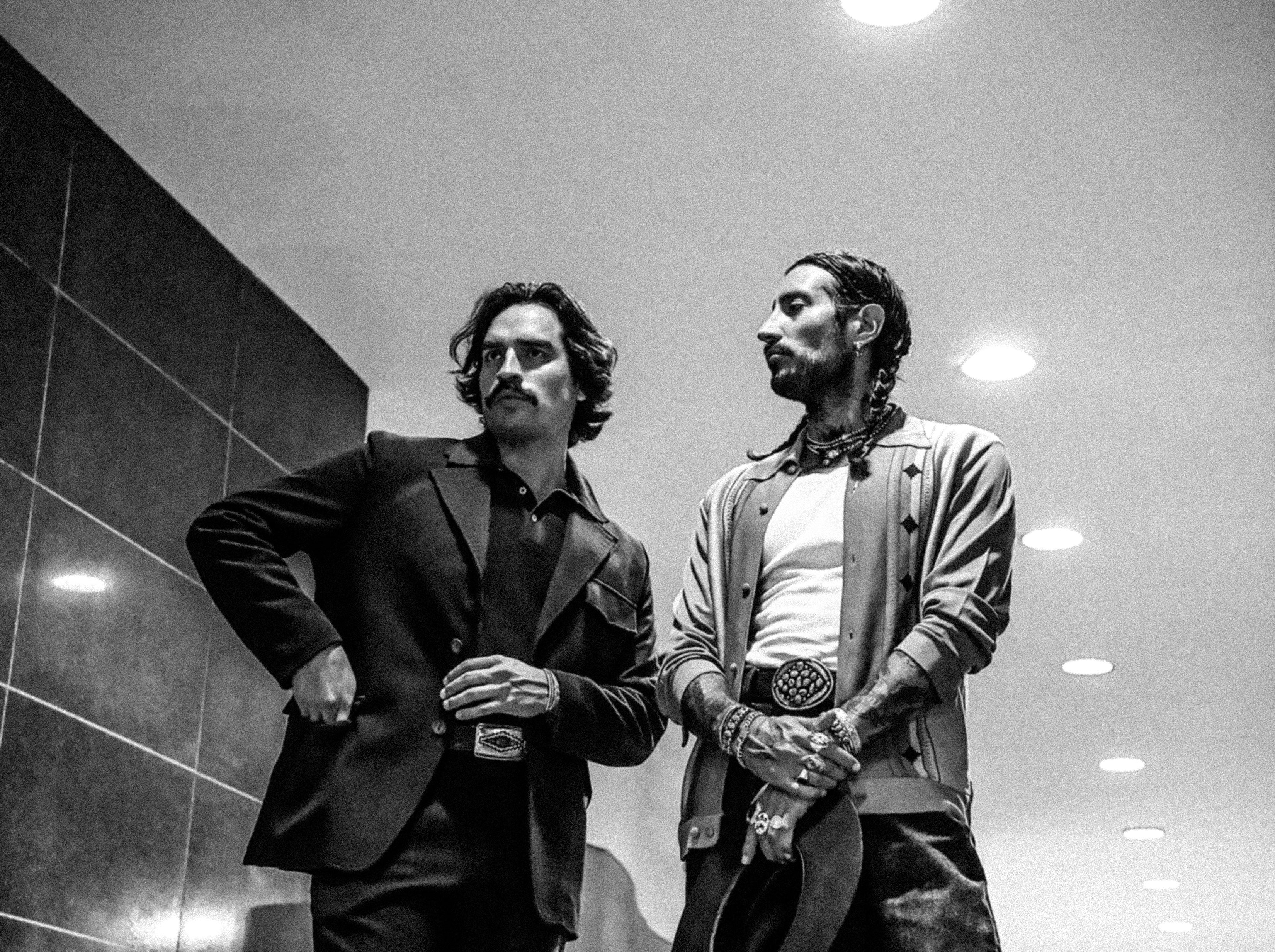
Over the course of a decade and 6 albums, Estevan and his brother Alejandro Gutiérrez have spun instrumental gold with their intricately intertwined guitars. The critically-acclaimed duo has commingled two continents worth of Latin sounds, surf music, western flourishes and melancholia to conjure a variety of landscapes and moods, from the romance of the desert to the vastness of space to the gauzy psychedelia of the mind.
With Los Ojos Del Condor, Hermanos Gutiérrez take flight.
Produced once again with Dan Auerbach of The Black Keys at his Easy Eye Sound studios in Nashville, the Swiss-Ecuadorian siblings reach a new stage in their storytelling with 10 tracks that tightly bind them to their roots and introduce a clutch of new colors to their palette.
The culture that shaped and continues to shape them is rooted not just in their mother’s native Ecuador and great-grandmother’s Peruvian heritage, but also the continent-spanning expanse of the Andean mountain range, the cerulean shores of the Pacific ebbing and flowing on the west coast, the sounds of Argentinean milonga and the Peruvian-Colombian melange of Cumbia and so much more.
“As brothers, we are very similar, but then also we have different tastes,” says Estevan of the pair’s push into new sounds. “For example, I love salsa, my brother loves cumbia. For somebody that doesn't know Latin music they think, ‘It's almost the same,’ But it's not. So whenever we compose new stuff, you can always hear that difference.” It’s in those cracks where the duo thrives and innovates. “I really love Los Ojos Del Condor because we try to go back to the roots when we started as just two guitars, and I played this whole album on the nylon guitar that I got from my dad when I was 8.”
Interestingly, it was not just that first guitar from dad that inspired them but also his wanderlust. “We have a very beautiful photo of him from the ruins in Machu Picchu, I think from 1973,” says Alejandro of their father, whose subsequent travels took him to Colombia and Ecuador where he met their mother. “We saw that picture, and we loved it so much because he had this spirit of exploring and discovering South America by himself. Everything at the house that we grew up in, all the South American art, he collected.”
You can hear that sense of history in the album’s stately opening track “Canto Andino,” easing listeners in with a beguiling acoustic guitar figure before giving way to a wheedling organ floating in like mist and setting the mood.
“It was a good introduction to this world, to this new landscape,” says Alejandro. “That melody you hear in the chorus, that's very happy and then it turns back into the dark, low tones of the slide. It’s cool because that's actually how the weather works in the Andes. You’ve got sunshine and then all of a sudden it's so cloudy and looks like it might rain or even snow. ‘Canto Andino’ is a calling from that landscape that inspired us.”
They chose to name the album after the song “Los Ojos Del Condor” because they felt its combination of galloping rhythms and liquid lap steel sustains ably represent the album’s sensation of flying high over all of these landscapes like the mighty bird of the Ecuadorian flag. “The condor is the bird of the Andes,” says Alejandro . “It's like seeing something from that perspective and appreciating the beauty.”
In that song and several others (including “Ciudad Inca” and “Los Andes”) a recurring motif, sometimes on guitar, sometimes on organ, flutters and surges in the background propelling the songs forward and intentionally tying the album together.
“We had the honor of working again with incredible studio musicians,” says Estevan of their sessions in Nashville. “We told them our vision and the feeling of flying with a condor but, at the same time, we also had this train ride feeling that we wanted to integrate into the whole album, because each album is a journey.”
It was a specific locomotive sensibility they sought to include and ended up not only creating the motif but writing the song “Tren Macho,” inspired by a documentary about the long-running train of that name which carries passengers from Huancayo to Huancavelica. “It was the only way to connect the small villages in the Andes with water and food,” Estevan continues. “And so we loved that train was symbolizing feeding the people in the Andes. We thought, sometimes it feels a bit like we’re also feeding our fans with our music. So we wanted people to really feel like they are on a train through the Andes. The studio musicians, they really helped us to add some details.”
Another new element on Los Ojos Del Condor is Alejandro's work on the charango guitar, which can be heard throughout the album on “Canto Andino,” “Ciudad Inca,” “La Danza Del Viento,” and “Tren Macho.” “It was a very intentional decision to introduce this guitar that has its origins in the Andean region of South America,” says Alejandro. “We felt it would be a wonderful layer to add to the intros and within the songs to give the album a distinctive feeling — more earthy and organic than the records we've done in the past. Together with the long notes of the slide it should represent a musical interplay between the wings of the condor and the people from the Andes.”
One of the album’s quieter jewels is “Yanantin,” spun with a spider’s web delicacy of acoustic guitar and molten lap steel. The song takes its title from the concept of complementary differences, something Hermanos Gutiérrez obviously subscribes to and during their own visit to Machu Picchu they made a delightful discovery. “We looked to the left, and we asked the guide ‘Hey, what is this mountain called?’” recalls Alejandro. “They said ‘Oh, that one is called Yanantin, which at the same time is also a concept of complementary duality.’ We were like ‘Oh wow, that’s us!’”
The brothers do not seek to prescribe the listening experience for fans but simply invite them on the journey and to interpret it with their own ears and emotions.
“It’s 100% about them,” says Estevan. “Each person has their own journey. We capture what we feel in this moment. But the interesting part is to see what listeners feel. Sometimes they feel the same, but sometimes they feel stuff that is super interesting that it brings them back to their childhood. Most of the time they tell us stories about their families, their parents. A lot also come and say, ‘Hey, I wish I would have the same relationship with my brother.’ We love that they always share these thoughts with us.”
In addition to their own releases, the brothers have become sought after musical collaborators in the last few years working with such notable artists as Leon Bridges on the mesmerizing “Elegantly Wasted” and adding a haunting quality to Natalia Lafourcade’s “Luna Creciente.”
Most recently Alejandro and Estevan were enlisted to co-compose the score for the acclaimed Jack Johnson documentary SURFILMUSIC, chronicling the singer-songwriter’s journey from surfer to filmmaker to GRAMMY-nominated musician. Johnson fans since their teens, it was a dream assignment.
“We flew to LA to meet him and within 20 minutes we were friends,” says Estevan. “Writing songs with him felt really beautiful.” The pair will hit the road with Johnson in the fall and look forward to playing the songs live.
The album cover, a photo depicting two women and two llamas climbing a gentle hillside against an arresting blue sky filled with puffy clouds was caught by Estevan almost by chance.
“We traveled to Peru in March,” says Estevan of a mission to capture photos and film that would help amplify the album’s sonic landscapes. “We brought our analog and Super 8 cameras and took so many pictures. We were talking to these two women, and they were so cute with the llamas, it was just such an incredible moment. As we said goodbye, they walked up that hill, and we took that picture and everybody got goosebumps.” But, he adds with a laugh, “Because we took analog pictures, we were like, ‘Oh damn, we really hope that picture turned out good!’”
It did indeed and its organic capture — along with the back cover photo taken by Alejandro of Andean condors — on actual film ended up dovetailing perfectly with the handmade, home movie feel of an album meant to convey the story of a family and a place.
“In the last few years, the cover has always shown us,” says Alejandro of the brothers’ previous album sleeves. “With this journey through Peru and the Andes, we wondered if it made sense to show us again. And then we saw this picture, two women, the two llamas, and we loved the duality of it and the representation — it could be the two of us in another life or in another universe. We loved the connection, and realized, it's not always about us. It's more about the culture that we admire and that we honor. That duality is on the back cover too with the two condors flying. It goes back to the concept of ‘Yanantin.’”
“What’s cool is, in the end,” says Estevan, “I took the front cover, and my brother took the back cover. It's always yin and yang. It needs both.”
Eight years may separate Alejandro and Estevan in chronological age but there is virtually no space between the brothers musically, as they communicate with an almost telepathic quality, instrumentally and instinctually. Los Ojos Del Condor welcomes the listener into that familial embrace and invites us to soar alongside them.